Imperial Pale Ale With Citrus
Here's a little experiment I did today. After tasting my most recent IIPA I thought it could use a little more something in the flavor. Normally, I get a fair amount of citrus quality to the flavor of this beer through the use of Columbus, Chinook, Cascade and Sorachi Ace hops that I add late in the boil. (For those interested, here is the recipe for my Sorachi Ace Only IIPA).But, this time around those flavors and aromas are too subdued for my tastes. My normal solution to this dilemma is by dry hopping in the keg with an additional charge of Cascade or Sorachi Ace but I'm out of both of those hops and so I decided to try something new.
 I picked up some citrus fruit at the market which included a lemon, an orange and a grapefruit. I figured I would go straight to the source for the citrus characteristics I'm looking for in this beer. My process was as follows:
 I highly recommend this process but a word of caution is in order. The huge citrus flavors imparted by this process can be over the top if all of it is used in a five gallon keg. I found that I needed to remove the tea ball with the skins after only several hours because the flavors were getting too strong. It might be a good idea to save the tea ball addition and add it later if the liquid solution is not enough for you. In any case, if you have any questions, leave them here in the comment section for all to review or address.
 I picked up some citrus fruit at the market which included a lemon, an orange and a grapefruit. I figured I would go straight to the source for the citrus characteristics I'm looking for in this beer. My process was as follows:
- Clean one each - lemon, orange and grapefruit
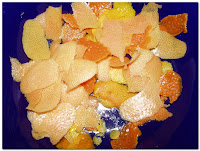
- Peel of just the outer most part of the skin (excluding the white pulpy part)
 Place in a sauce pan along with 1/4 cup sugar and 1-1/2 cup water
- Boil for 10 minutes
- Strain out the skins and place in a large tea ball
- Pour the citrus liquid into the full keg containing carbonated and chilled beer
- Lower tea ball with skins 3/4 of the way down into keg (lower and raise tea ball several times to mix in the citrus solution with the beer
 Place lid on keg and seal with co2 pressure
- Serve and enjoy


I was able to immediately sample the beer after this process and I was happily surprised at the amazing results. This technique added an ample amount of the blended citrus flavors and made what was a decent IIPA into an excellent beer with a distinctive and flavorful quality.
 I highly recommend this process but a word of caution is in order. The huge citrus flavors imparted by this process can be over the top if all of it is used in a five gallon keg. I found that I needed to remove the tea ball with the skins after only several hours because the flavors were getting too strong. It might be a good idea to save the tea ball addition and add it later if the liquid solution is not enough for you. In any case, if you have any questions, leave them here in the comment section for all to review or address.
Cheers!
Comments
Your citrus liquor idea sounds good. As far as my experiment, if I were to do this again I would add about 1/4 the amount of material to begin with and increase to taste. I think I may have added too much to begin with as the citrus is overwhelming. Live and learn. Cheers.
Yes, this technique is definately worth trying. I was able to infuse a huge citrus quality to this beer. But, as I said before, add incrementally until you reach the desired results. If you're adding this to a beer with citrus hops like cascade, centennial, etc. it's a great complement. Let us know how it turns out. Cheers!